
The Opening Night
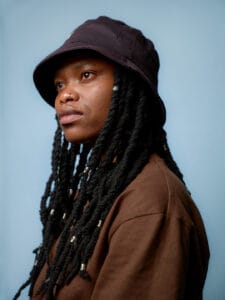
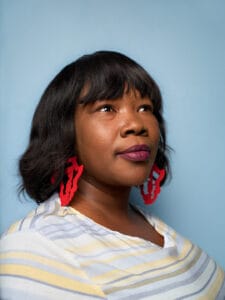
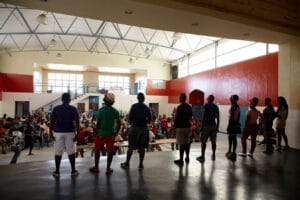
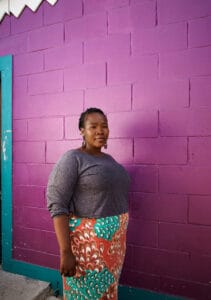
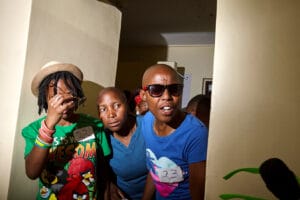
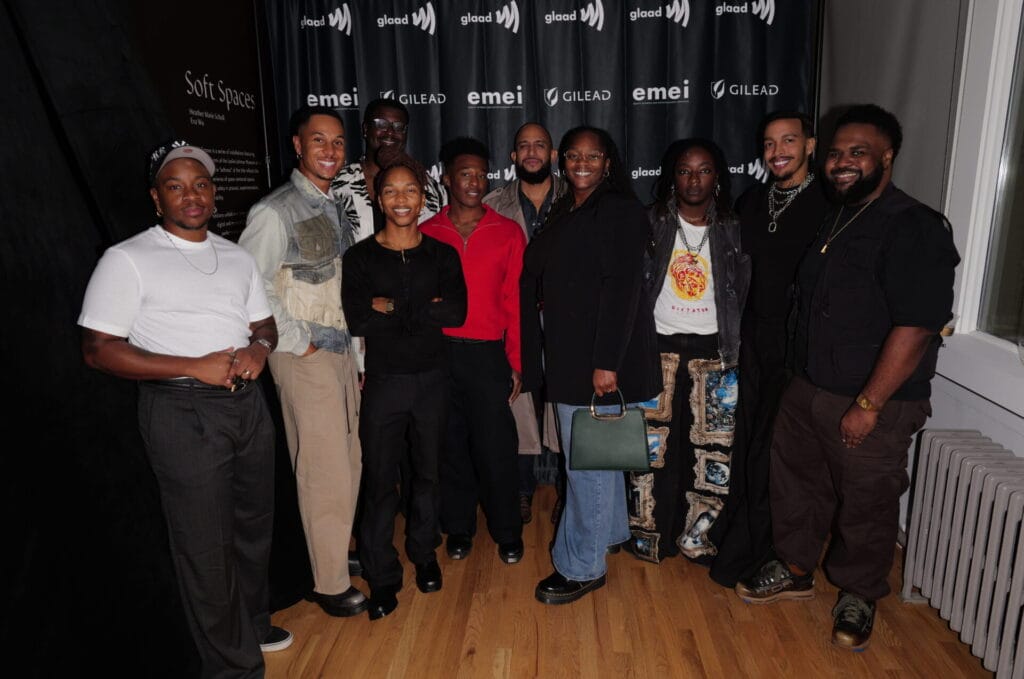
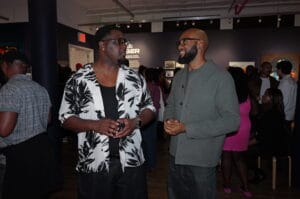
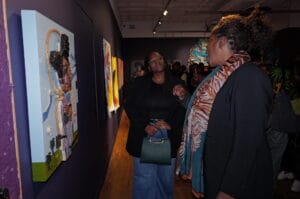
On the evening of Tuesday, September 29, the Leslie-Lohman Museum of Art in SoHo filled with the kind of noise every exhibition hopes for. From 6 to 10 p.m., more than 200 guests moved through Nemesis: Remember, the final exhibition of GLAAD’s Equity in Media and Entertainment Initiative (EMEI) Year 3 cohort.
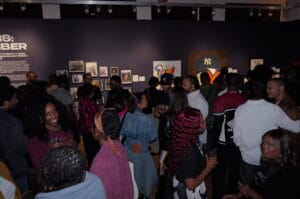
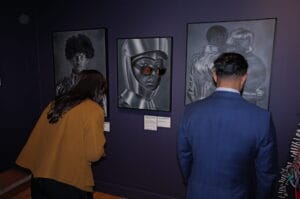
The space felt warm and inviting from the first step inside. Oil paintings glowed in deep reds and emerald greens. Graphite drawings hung beside photographs of Black queer people at home. A tall, hooded textile woven from elastics and fabric from Dakar, Senegal stood as a memorial. Guests leaned in to read the wall text and turned to the person beside them to ask, “Have you seen this one?”
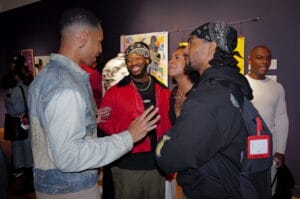
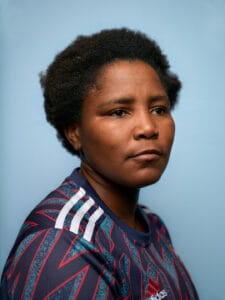
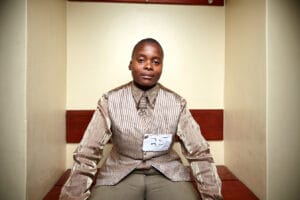
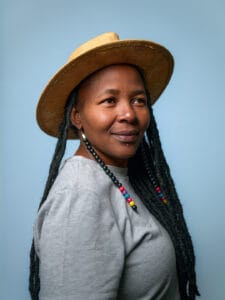
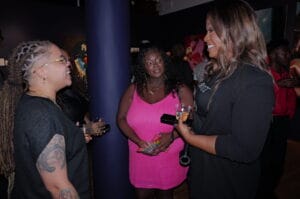
When there wasn’t a panel underway, the room never went quiet. People talked, mingled, and lingered in front of the work. After a year alongside this cohort, the word I keep reaching for is kin: community doing what community does best, kinfolk lifting up kinfolk. Ten Black queer artists, each of whom had spent a year making new work, were finally standing in a room with the people that work was made for.
Why This Exhibition Exists
According to GLAAD’s 2026 State of HIV Stigma Report, 72% of Americans have not seen stories of people living with HIV in the media, and the gap between scientific progress and public understanding is widening. One-third of Gen Z say they are not knowledgeable about HIV prevention and treatment. Nemesis: Remember was built as an answer to that gap. If you want to see what’s driving it, GLAAD’s 2026 State of HIV Stigma Report breaks down how Americans’ knowledge, comfort, and media exposure around HIV have changed, and where the biggest gaps remain.
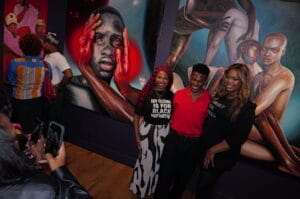
GLAAD launched EMEI in 2022 with support from Gilead Sciences as a pipeline program to close the gap in equitable representation for Black LGBTQ storytellers and people living with HIV. Its three year-long cohorts have supported filmmakers, music artists, songwriters, and producers, and now visual creators. The Year 3 cohort brought together these artists based in Los Angeles, Houston, Richmond, Metro-Atlanta, Philadelphia, New Orleans, and New York. Each artist received $10,000 to create new work and met monthly with GLAAD’s Community and Media team and mentors on the road to the exhibition.
Curator Damon Epps, a creative producer who directed and produced a Webby-nominated documentary about the Year 2 cohort and co-founded the GLAAD Media Award-nominated Surface Level podcast, borrowed the exhibition’s title from Benjamin Clementine’s song of the same name. When truth is treated as a foe, art becomes its nemesis, a keeper of truth that always remembers. The show posed a question to everyone who walked in: “When tasked with remembering, will you be a friend or a foe to truth?” Damon believed the answer belongs to all of us, because, as he puts it, HIV is not a “me” problem but a collective “we” problem, one met through science and through a holistic approach to care. Powered by Gilead Sciences, supported by Publicis Groupe, and hosted by the Leslie-Lohman Museum of Art, Nemesis: Remember put that “we” on the walls.
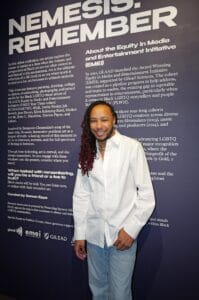
The Artist Preview: A Room Full of Audacity
The weeklong exhibition experience began hours before the first guests arrived for the opening night reception. That Tuesday afternoon, the artists had the gallery to themselves, along with a small circle of industry mentors: Brandon Garrett, Impact & Equity Leader at Publicis Groupe; David Everitt Howe, Senior Arts Editor at Pioneer Works; Donja R. Love, playwright and founder of Write It Out!, a fellowship for playwrights living with HIV/AIDS; and Chloe Ming, Assistant Curator & Exhibitions Manager at the Leslie-Lohman Museum of Art. Each artist walked the mentors through their work, and the mentors shared what they had learned in their own careers.
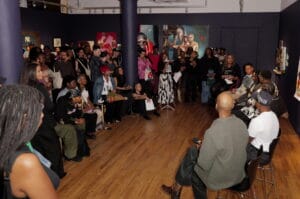
One message from the end of that conversation has stayed with me, and it is for every creative and entrepreneur reading this now: have the audacity. Remember your talent and your calling. Apply for the residency that feels out of reach. Reach out to the person who seems miles ahead of you. The journey isn’t linear, but you don’t have to wait until you’ve “arrived” to walk in with the confidence you’ll have at the height of your career. Your talent, your worthiness, and your right to belong are already there. Shed the imposter syndrome and own your greatness.
Ten Artists, One Memorial Quilt
In 1985, activist Cleve Jones saw a wall of placards bearing the names of people who had died of AIDS, and the AIDS Memorial Quilt was born. Walking the gallery, I felt its legacy all around me. Every piece in the room was its own panel in a larger memorial, each a different way of remembering, and together they told a story of Black queer life in full: grief and joy, armor and tenderness, silence and celebration, all of it remembered.
BCIMANARTIST (Darian Stewart) (@bcimanartist)
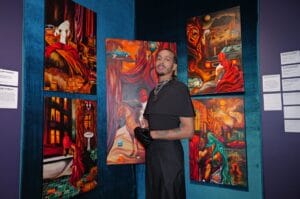
Darian Stewart, also known as BCIMANARTIST, was born and raised in Hardy, Arkansas, and is now based in New York. His series The longest night lasted years turns the hours of the clock into surreal oil paintings, from 9PM | lost in the desert to 3AM | drifting in tub silence, alongside 4AM | tile confessions, a four-by-four-foot panel of beads, rhinestones, and fabric on tile. In saturated red, orange, and emerald, a hooded figure crouches at a bathtub, windows glow with the silhouettes of neighbors, and a melting clock hangs over a desert gas station. On the panel, he explained why these pieces matter: in Arkansas, education about HIV stigma isn’t always within reach, so when he returns home to speak about his work, people see themselves in it and learn from it.
BE3K (Anthony Badon) (@be3k_)
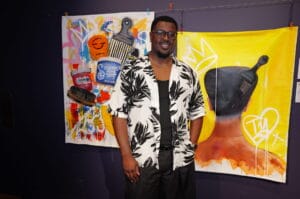
Born in McComb, Mississippi, and now based in New Orleans, Anthony Badon, who goes by the artist name BE3K, paints what he calls “full, vibrant, undeniable human beings.” Thank you for shopping with us. Have A Great. Day honors the neighborhood beauty supply store: Blue Magic, Murray’s, a pick, and a brush crowd a graffiti-splashed canvas beside a peeling yellow smiley face that recalls the plastic bags handed across every counter. In Protect Your Crown, a figure seen from behind wears a fist pick in his hair against sunflower yellow. Daily rituals of Black hair care become acts of love and protection.
Devin Wesley (@devinwesleyy)
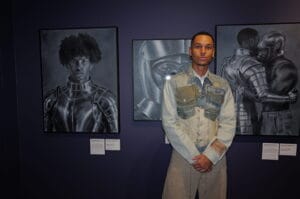
A former track and field athlete whose path shifted after a career-ending injury, Los Angeles-based Devin Wesley paints, in black and white, the armor Black men have built to survive, and the vulnerability that is just as vital to survival. In In Shining Armor, a body is guarded in gleaming plate while the face stays bare. To Let Be Revealed, in oil and tinted mirror, reverses the act of looking. In Brothers In A War, two men in armor embrace, making vulnerability a picture of strength. When asked on the panel how his work reaches people, Devin explained that stigma persists because there is so little representation of people living with HIV who lead full, joyful, multifaceted lives, and that his paintings widen how we understand Black identity, especially Black men.
Jah Beverly (@jahbeverly)
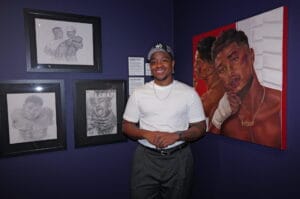
Self-taught and based in Philadelphia, Jah Beverly reimagines masculinity through his identity as a Black Trans man in XOXO, a graphite series centering Black Trans men and the beauty, intimacy, and complexity of Trans relationships. BoiCrazy rewrites the 1990s hyper-gendered magazine cover, barcode and all, with Black Trans masculinity at the center. In Desire, the subject’s upward gaze gives the viewer the power, and Good Boy explores the ease of T4T intimacy. “By changing the stories we tell,” he explains, “we can begin to change the culture that surrounds them.”
José Duran (@joseduranstudio)
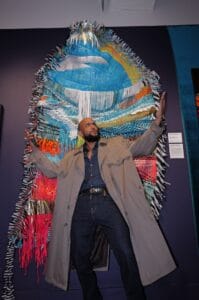
Born in Moca, Dominican Republic, and based in New York, José made Charo, a nearly ten-foot-tall hooded textile of woven elastics and metallic fabric from Dakar, striped in turquoise, orange, hot pink, and black with a band of gold. Made in honor of friends lost to HIV/AIDS, it draws on the AIDS Memorial Quilt, first unfurled on the National Mall in Washington, D.C., in 1987, when 1,920 panels covered a space larger than a football field. Like the Quilt, it is both memorial and protective shroud, the intimacy of a blanket offered to someone we care for. In José’s words, “Young people need to see HIV represented in ways that go beyond fear, shame, or tragedy.”
Kiera Rahming-Reed (@summerorchidbykey)
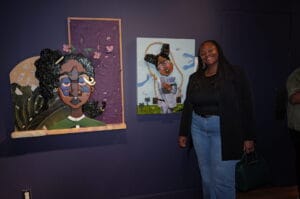
Metro-Atlanta artist Kiera Rahming-Reed builds what she calls emotional architecture from carved wood, wallpaper, papercrete, ceramic, and rope. Before I Knew Shame, I Just Wanted To Play shows a girl on a rope swing against a pale blue sky, blue hands reaching in from the edges, and asks what parts of our unguarded earlier selves we can recover. The House I Carried considers how the places we come from become structures inside us, shaping what we learn to hide. She brings that same lens to HIV stigma: “We can shift these narratives by depicting people living full, healthy, and vibrant lives,” she explains. “Having these stories out in the world eliminates the stigma.”
Modest Art 88 (Russell Scott) (@modestart88)
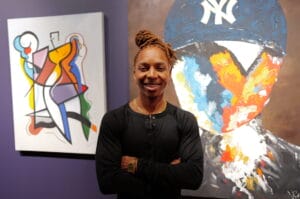
Brooklyn-born, Los Angeles-based Russell Scott is a self-taught artist and dancer who paints as Modest Art 88 and founded Creative Genius Academy, a mobile arts program for underserved youth. Puzzled turns angular shapes in orange, blue, and red into a study of not having the answers and still needing to release what is inside. N.Y. State of Mind, inspired by Cassidy’s “I’m a Hustla,” shows a figure in a Yankees cap whose face is a burst of thick color over raw plaster. He explained that the two pieces come from two contrasting emotions that coexist: “One piece to me is more of my chaos, and the other one is more of my calm.” Seen side by side, they could be the work of two different artists, he said, but both are him, from two different emotional standpoints.
Ryan C. Hamilton (@ryanchamilton)
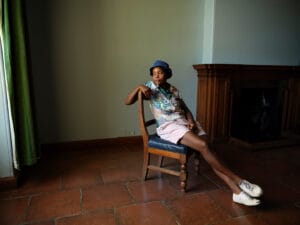
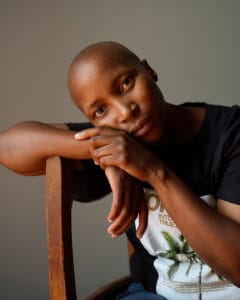
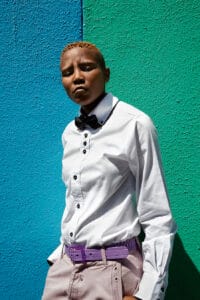
Brooklyn-based documentary photographer Ryan C. Hamilton presented When I’m Home, sixteen pigment prints of Black queer people in the spaces they call home: a man leaning against a bedroom wall, another lying back with his hands behind his head, a third in a patterned robe in a richly colored living room. Rather than spectacle, the photographs center the simplicity of Black queer existence. Together they form a visual archive that affirms being seen not only through struggle or resistance, but through the quiet act of being at home. He explains that he hopes to create “work where people can see themselves and feel worthy of being documented and archived.”
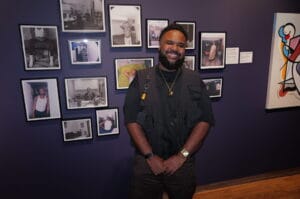
Travion Payne (@travipayne)
Houston-based Travion Payne merges a background in psychology with vibrant, textured portraiture in two large oil paintings, Forsaken III and Focus. In one, glossy bodies tangle in deep teal shadow beneath a single red light, a scene where a touch may offer comfort or restraint and closeness can coexist with distance. In the other, a man presses glowing red hands to a tearful face. Fragmented Braille clocks with missing numbers turn memory loss into something felt rather than seen, and the red hands point to how trauma can come from the people closest to us. The paintings treat detachment as both a consequence of trauma and a means of survival: not an absence of feeling, but a response to having felt too much for too long.
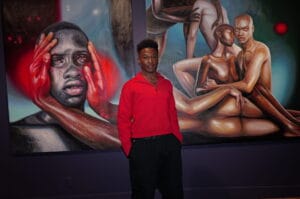
Zakari Yonkers (@zuhkarii)
Richmond, Virginia, artist Zakari specializes in portraiture, drawing on the people and places around them to explore identity, community, and self-expression. Genius Child, named for the Langston Hughes poem, is a series of mixed-media portraits built from interviews with artists about their practice and how personal experience shapes the work they make. It asks what it means to be an exceptional Black queer artist in a time when art isn’t celebrated. Nobody loves a genius child. The portrait of Farrah bursts with pink, blue stars, and a bunny-eared unicorn, a reminder that joy is part of the record too. Zakari explains that they hope to see more people living with HIV sharing their stories, because “the more we learn about our neighbors, the more empathy and compassion we develop for one another.”
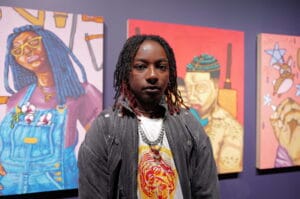
Remarks and Two Fireside Chats (Truth, Laughter and Care)
Julian J. Walker, GLAAD’s Associate Director, Community and Media, opened the evening’s program by naming the gap the exhibition exists to close: too few Americans have ever seen a story about someone living with HIV. He reminded guests that everyone has the power to change that reality by sharing the experience, meeting the artists, buying work, and bringing friends and family to the gallery. “The world wants our stories,” he told the creatives in the room, “and they need them.”
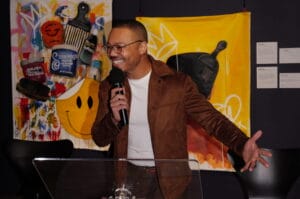
GLAAD President and CEO Sarah Kate Ellis noted that GLAAD was founded forty years ago in New York City on the principle that media shapes culture, and that Black queer storytellers now face shrinking platforms and systemic erasure. Confronting HIV stigma, she said, means changing both how stories are told and who tells them.
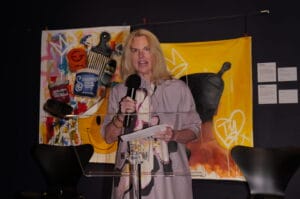
Darwin Thompson, Senior Director, Corporate Responsibility at Gilead Sciences, said stigma is one of the biggest barriers between people and care, and that art is an answer to it. “Your work honors our families, our rituals, from the barbershop to the ballroom to the dinner table,” he told the artists. “It holds our history, and it imagines the future we deserve.” He left the room with three asks: invest in the work by buying a piece or commissioning an artist; share their stories and say their names; and help end HIV stigma in your own circles by talking openly, encouraging testing, and speaking up when you hear shame or misinformation.
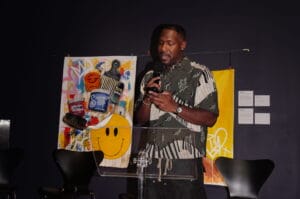
Two fireside chats followed, moderated by Shar Jossell, GLAAD’s Senior Entertainment, Culture, and News Media Engagement Consultant, an award-winning journalist and culture critic and president of the Los Angeles chapter of the National Association of Black Journalists (NABJ-LA). In classic Shar fashion, she set the tone with laughter and then moved the room into introspection, and the artists followed her there. All ten artists took part, joined by curator Damon Epps in the first conversation and by Brandon Garrett of Publicis Groupe in the second.
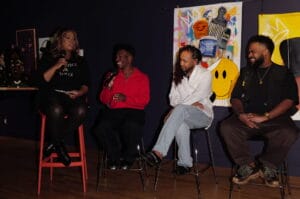
One question cut to the heart of the show: how does the work reach people who have never questioned HIV stigma, and people already living inside it? The answers were personal. One artist spoke of losing a loved one to HIV-related complications years ago, an experience that made clear HIV is not something to whisper about, and said we are all the same people walking the same roads, no matter our status. Another, who grew up in the Midwest, reflected on the people who were never documented and spoke of feeling a personal responsibility to make sure their stories survive. A third remembered that in the small town where they grew up, the answer to HIV was prayer, with no education and no conversation beyond it. Without understanding, they said, these stories get shrouded in darkness and hidden away, which is why they stressed education and visibility and insisted this is not a taboo subject. Another artist reminded us that stigma persists because there is so little representation of people with HIV living full, joyful lives.
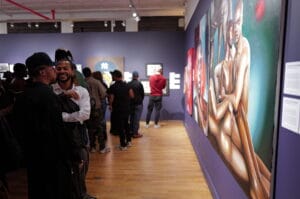
Brandon Garrett said being in the gallery reinforced for him that your identity is not the product. He urged brands to move “from representation to resonance.” Real inclusion, he explained, doesn’t stop at putting a Black person in the room. It means honest storytelling, care, and intention, and it extends into opening real access and resources for Black and other marginalized communities.
Keep the Conversation Going
The exhibition closed Sunday, October 4, but the work is not finished, and neither are these artists. Visit the exhibition page and the Year 3 cohort page to learn more about the cohort. Each artist’s name above links to their website, with their Instagram handle beside it. Follow, share, commission, and buy!
With Gratitude
This exhibition was a labor of love. Our team spent a year with an exceptional cohort, and we knew from the moment we met them that they deserved a beautiful night.
The evening was only as special as every person who made it happen. Thank you to GLAAD’s Community and Media team: Julian J. Walker, Ty Ballard, Alexander King, and Shar Jossell, alongside myself. Thank you to our Events team, Dashka Gabriel and Crystal Harrell; to Yolanda Lenge, Jose Useche, Lilly McNicholas, Anthony Allen Ramos, Heidi Spillum, Roho Yniguez, and Nora Molinaro; and to GLAAD’s leadership team for their guidance. Thank you to Damon Epps for his curatorial vision, and to Shar for hosting our conversations with such grace.
Thank you to the Leslie-Lohman Museum of Art for opening your space to us. Our partnership began when Aimée Chan-Lindquist, Director of External Affairs, joined a monthly cohort meeting as a guest mentor earlier this spring, and the team and cohort were immediately enamored. We are grateful to her, to Abraham Cone, Development Manager, and to the entire Leslie-Lohman team for teaching us what it takes to make an exhibition possible. Thank you also to Pioneer Works, Gilead Sciences, and Publicis Groupe.
Finally, thank you to DaShawn Usher, former Vice President of Community and Media at GLAAD, who created EMEI in 2022. This exhibition exists because of the pipeline he built for Black LGBTQ storytellers. He is now building community through MOBI, which he founded, and a new consulting practice.
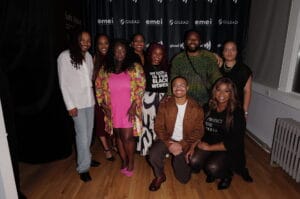
The pieces will come down, but the stories remain. The artists have asked us to remember, and I hope you will.