Trending
- WATCH: Brooks Marks on building his brand, backing his people and who brings the drama on “Next Gen NYC”
- Meet the Year 3 EMEI Cohort: The Artist L. Haz
- WATCH: “Women are the Best!” Sarah Jane Nader and Amber Glenn are Queering the Stage on Season 35 of “Dancing with the Stars”
- GLAAD, Local Leaders Respond to Anti-LGBTQ Shooting at Tucson Queer Bar
- Meet the Year 3 EMEI Cohort: Ryan C. Hamilton
- WATCH: “Love Island USA” Host Ariana Madix on Manifesting, Blocking the Haters and Making Room for Queer Love in the Villa
- GLAAD to Toronto for TIFF: The Market, Festival and Celebrating LGBTQ Stories
- WATCH: D’Arcy Carden Celebrates Season 2 Renewal of Peacock’s Smash Hit ‘The Five-Star Weekend’ and Her Character’s Queer Awakening
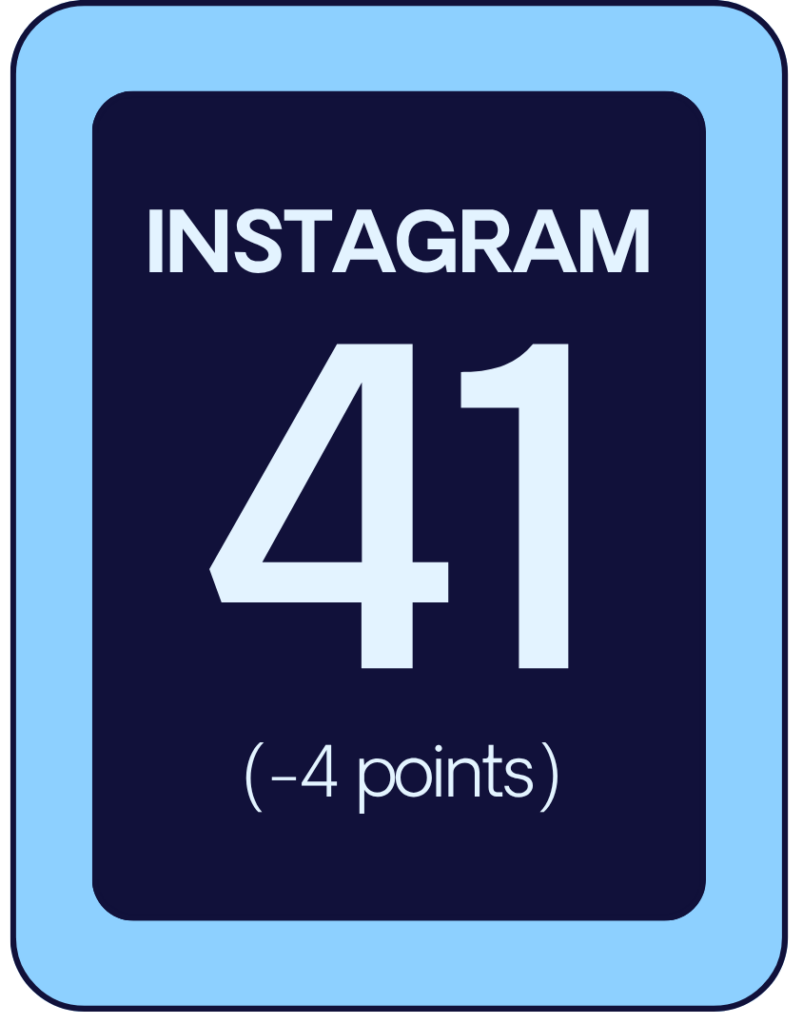

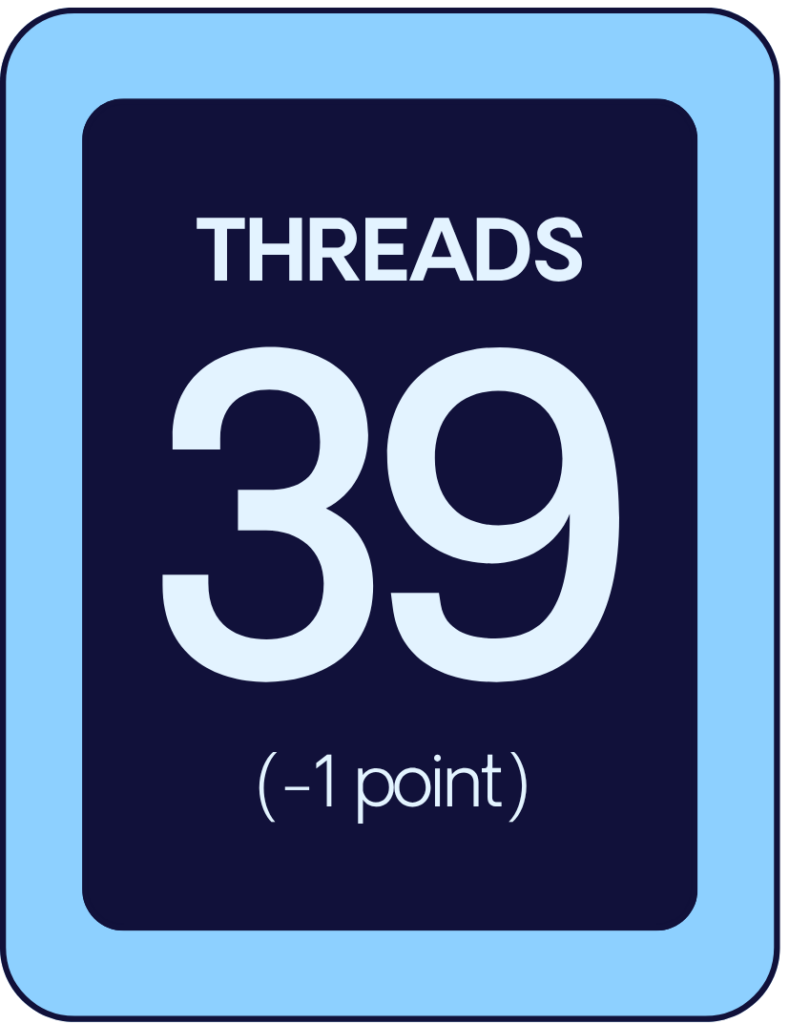
This year, all three Meta platforms see declines — Instagram receives a score of 41 (a four-point decrease), Facebook a score of 40 (a five-point decrease), and Threads a score of 39 (a one-point decrease). As GLAAD highlighted in last year’s report, widely denounced[1] changes to Meta’s “Hateful Conduct” policy in January 2025 removed critical protections for LGBTQ people, especially transgender and nonbinary people, and other historically marginalized groups across the company’s platforms. Among other harmful edits, the updated hate speech policy continues to explicitly permit users to characterize LGBTQ people as “mentally ill” or abnormal.[2] The policy also invokes the right-wing term “transgenderism,” an anti-trans term that falsely frames being transgender as an ideology rather than an innate identity.[3]
These safety rollbacks were not only condemned by GLAAD[4] and other civil society organizations,[5] but rebuked by some employees[6] and Meta’s own Oversight Board.[7] In April 2025, the Board responded to user complaints about two videos shared by an influential anti-LGBTQ account that featured the intentional misgendering of a transgender woman and girl.[8] The Board’s majority sided with Meta’s decision to leave both videos up, arguing that the posts did not incite violence or discrimination.[9] However, the Board expressed concerns about Meta’s addition of “transgenderism” to its Community Standards, recommending that the company remove the term “to ensure Meta’s content policies are framed neutrally and in line with international human rights standards.” The Board further advised: “For its rules to have legitimacy, Meta must seek to frame its content policies neutrally, in ways that respect human rights principles of equality and non-discrimination. This could be achieved, for example, by stating ‘discourse about gender identity and sexual orientation’ in place of ‘discourse about transgenderism and homosexuality.’” In its formal response, Meta stated only that it would “consider ways to update the terminology.”[10] In the appendix of its March 2026 Bi-Annual Report on the Oversight Board — nearly a year later — the company stated that it was still “assessing feasibility” regarding the proposed change.[11]
Consistent with the Board’s guidance, Meta should remove harmful exceptions from its “Hateful Conduct” policy and provide LGBTQ people with strong protections against hate, harassment, and violence across its platforms.
On its “LGBTQ Safety” page, Meta published a “Gender Identity Policy and User Tools” policy in March 2023. The page includes language from the company’s old hate speech policy (prior to its January 7, 2025 updates), specifically a commitment to protecting trans, nonbinary, and gender non-conforming people from “claims about [their] sexual orientation or gender identity.” Since this document conflicts with the company’s official Hateful Conduct policy and was published more than three years ago, it seems unlikely that this policy is still active and enforced by moderators.[12] In addition to restoring best–practice policies protecting LGBTQ users, Meta should adopt an explicit policy against targeted misgendering and deadnaming in its Community Standards.
As in previous years, Meta continues to provide minimal information about the options users have to control whether and how the company processes data related to their sexual orientation and gender identity (SOGI). For example, Meta fails to clarify whether users can control how their inferred or collected SOGI information is used in the development of algorithmic or other automated systems. In December 2025, Meta updated its privacy policy to include its generative AI products, stating that, “to provide, personalize and improve our Products,” the company will collect data from users’ interactions with Meta’s AI tools (e.g. Llama) to inform targeted advertising.[13] In the U.S. and other countries outside of the E.U. and U.K., Meta does not allow users to opt out.[14]
This policy update further compounds concerns about users’ lack of control over their personal data, given the company’s already pervasive data collection practices.[15] Contrary to some online claims, however, the updated privacy policy does not allow Meta to see or collect data from person-to-person DMs.[16] The company has also used data from users, including public posts, photos, and comments, to train its AI models since at least June 2024.[17] (For E.U. and U.K. users, Meta provides an option to submit a “Right to Object” form in the Privacy Center. If approved, Meta will stop using their public content to train its future models.) Meta should give all users clear options to control the collection, inference, and use of their personal data, including how the company uses information related to their sexual orientation and gender identity for the development of algorithmic and other automated systems.
Lastly, Meta has taken significant steps back when it comes to its public commitments of creating a more inclusive workforce[18] and fostering civil rights. The last time that Meta publicly discussed holding civil rights trainings was in March 2023, when it published “An Update on Meta’s Civil Rights Progress.” According to the company, it introduced “civil rights training for employees to better equip them to identify and address civil rights issues in their day-to-day work. Since [Meta] launched the training in July 2022, it has been taken by more than 50,000 full-time employees.” But following the 2024 presidential election and the current administration’s executive orders targeting DEI programs and mandates, Meta announced it would abandon its DEI commitments and hiring targets.[19] GLAAD’s research also shows that Meta did not publish any updated diversity hiring data in 2025. Meta should renew its commitments to taking proactive steps towards creating a more diverse workforce, and publish annual data that tracks progress towards this goal.